Now no, we’re not getting into that woke bandwagon that the ubiquitous Ed Sheeran is so happy to jump on.
And accept it as Midge’s metaphor.
But we digress, Midge will know as many travellers from these North Atlantic islands we call Britain and Ireland, that Tenerife is an island of contrasts.
And not least weatherwise.
Winter to warmer
Part of the scenery: In Tenerife
Our friends at Canarian Weekly reported over Christmastime that ‘a hailstorm was captured on video in the municipality of El Tanque at around 6pm.
‘The hail was linked to an anvil-shaped convective cumulus cloud that also brought wintry conditions.
‘To the peaks of Chasna and the western areas of Teide National Park.
‘The snowfall extended to other high-altitude areas, including La Palma.
‘Where the Villa de Garafía was seen blanketed in snow, delighting locals and visitors.’
Palm and sun day: In Garachico
Now those of us who venture further north and west and to centre of the island.
Away from the southern hotspots will recognise the topographical and meteorological differences in only a matter of miles.
An island of contrasts
Brolly good show: Garahotel
All of which means you can enjoy a land which can double for sci-fi and prehistoric films in Mount Teide.
There’s no denying that Rio is the world’s biggest carnival with two million people taking to the streets but a quarter of a million attend the Santa Cruz carnival on the island.
So what’s it all about and when is it?
Well, it’s rooted in Christian tradition and so that’s two weeks before Ash Wednesday.
And for those of you who forgot that man that thou art dust and unto dust thou shalt return then that’s January 20-February 26.
And now for the history
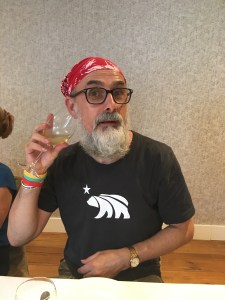
Party Girls: Bandanaman and his walking troupe
The history of the Carnival falls into three distinct periods…
The Iberians’ religiosity, the more spirited Twenties-orientated festival and the reinvention of the party from 1961 when it took on many of the features we enjoy today.
Now for a timetable of event and what it all mean we got the Tinerfenos to do the heavy lifting.
And with memories of our hike on the island with CanariaWays and our walk through the ages we know they do it far better than us.
So over to them.
The Queen of Tenerife
Spanish meal anyone: And preparing the dish of the day
And that would be Eva from our walk up to Afur which she took in her stride and then did yoga up at the Franco-themed bar (don’t ask).
And I’d vote for her for the Carnival Queen.
15 February – Carnival Queen Election Gala
The Carnival Queen Election Gala is when the Carnival Queen is crowned, who is chosen amongst over a dozen candidates.
The contestants wear the most spectacular costumes, made mainly of feathers, plastic, metal and rhinestones and weighing up to 400kg.
And this year we will see the first-ever junior Gala King.
Reign on our parade
Queen for a day: The carnival
And what would a carnival be without the sing-song?
17 February – Opening Parade of the Carnival
The carnival is a sea of colour, featuring the lead Carnival Queen.
Murga street music groups, comparsa bands and rondallas playing traditional old carnival songs parading down the streets of Santa Cruz.
All in it together
Take to the streets: On Tenerife
And that means a dance.
21 February – Big Carnival Parade in Santa Cruz
The Coso Apoteosis is arguably the highlight of the entire festivities.
Visitors from all around the world flock to Anaga Avenue in Santa Cruz to witness the spectacle.
It features all the Carnival Queens and Carnival groups, floats, incredible dance routines and musical performances.
Catch of the day
Packed in like… sardines
Now Spaniards and Canarians have their own particular take on carnivals which means:
22 February 2023: Burial of the Sardine – A humorous and grotesque procession of mourners saying goodbye to the carnival celebrations.
19 February & 25 February 2023: Daytime Carnival – A popular event for children and families, featuring plenty of activities to keep all entertained.
26 February 2023: Parade of Vintage Cars, Piñata and End of Party – And there’s nothing like whacking a bag of sweeties to get the juices flowing.
Free-for-all
Me-me and Dee-Dee at Crop Over in Barbados
In addition to the ticketed official carnival events, there are a number of spontaneous street events/activities to enjoy for free.
We’re advised that one of these night carnival parties is a must.
And we know all about what dancing in the dark is all about from Crop Over in Barbados.
And a glossary
Echoes of the Canaries: And special wine
Of course, when you’re in Espana then it helps to have a couple of words.
Albergue, meaning hostel, and pulpo, the Spanish word for octopus.
Carnival Groups
A carnival group is a group of people who work together creating ideas, costumes, music, choreography, who all march together in the parade.
Tenerife Carnival features hundreds of different groups but two of the key ones to look out for are below:
Murgas: The Murgas are Spanish carnival groups that feature satire artists, performing songs about current political and world events.
Comparsas: The “comparsas” represent the Brazilian influence on Tenerife’s Carnival, filling it with rhythm, colour and joy.
Nowadays, the comparsas own the street with the undeniable quality of their live performances to surprise even the most frequent carnival-goers on their nights out.
Rondallas: The Rondallas are carnival groups that consist of only guitars, bandurrias, lauds and octavinas.
And of course there is a museum celebrating it all…
At La Casa Del Carnaval, located in Barranco de Santos next to the bridge Puente Galcerán
Maybe add to that glossary for next year Noo Yoikas… because they want to be a part of it Tenerife.
Things are looking up again in Travel and particularly in starry Pyrenees and Tenerife.
The sky truly is the limit, and beyond, up there in the mountains of France and the Canary Islands.
Cheesy: Yes, but I don’t care
Just pick your time when you’re going up, up and away to Le Pic du Midi.
Of course this dreamer had his head in the clouds when he returned to the Pyrenees from Lourdes.
Through the lens: With Big Jim in the Pyrenees
And I saw nothing through the mist though that may have as much to do with the vin I imbibed at Le 2877.
I was reliably informed by my Travel Partner in Jim, the inimitable Jim Gallagher, that the stars do come out at night.
As Big Jim had stayed over at the top of the world.
Where he got to open the curtains onto a Twinkle Twinkle Little Star world.
Sahara bumpity
Caught in the storm: The Sahara
Of course it’s the one thing we all share in common, the Milky Way around us.
And it’s the most spectacular free light show.
And a silver lining when you’re inconvenienced in the conveniences of a Sahara Desert malfunctioning open-roofed toilet.
With the roof off and me fixed to a seat when the rest of our party were sleeping in their tents (avoid Atlas Mountain roadside cafe tagines) I got to see shooting stars and the sunrise.
It might have been Morocky in Morocco but that was a highlight.
Tidy in Mount Teide
Sky high: In Mount Teide
I went one better out in Tenerife on Mount Teide in Tenerife some years later, all in the company of one of those nutty astronomers we all love.
Through our telescope we saw Uranus (stop sniggering up the back)!
All of which came flooding back with the release of some of the best places to go star-spotting by vision care experts Lenstore.
They have analysed 29 locations across the globe to determine the greatest stargazing spots.
It’s all based on the visibility of stars due to low light pollution and their popularity according to monthly search volume data.
And here is what they found…
The only star in the sky: At Le Pic du Medi
France, Spain, Ireland and Germany dominate the rankings in Europe for stellar stargazing spots.
Yes, with Pic du Midi with a light pollution level of 0.12 and a total monthly search volume of 30…
It’s enough to make you want to dance.
Tenerife and La Palma take the second and third spots.
They boast an extremely low light pollution level of -0.01 on average making the stars most visible.
And for those wanting to travel further afield, Mauna Kea on the island of Hawaii takes is the best location globally for stargazersf.
And that’s thanks to its low levels of light pollution (-0.03).
How highie Hawaii?
Aloha: Hawaii
All of which is why my old scientific pal from Italian classes in Edinburgh took himself out there to their observatory to gaze for himself.
No, didn’t get there yet or master Italian to any level but that’s a different story.
So, all you fellow stargazers check out the list for yourself and get squinting through a lens.
Maybe see you there, whether it’s the starry Pyrenees or Tenerife.
The WHO plumped for the naming system so as to remove stigma from countries after the media jumped on the first Covid variant.
And our news gatherers lazily called it the South African variant.
Now we here at TravelTravelTravel being internationalists fully support their motives, particularly because jingoism and racism can run as wild as pandemics.
And it is to the Greeks that we have turned for wisdom and philosophy.
Lay off the Spanish
With queen of Spain Teresa, Eoghan Corry and Sharon Jordan in Dublin
Back in 1918 when the last global pandemic broke out it was tagged the Spanish Flu, the name by which it is still referred.
And this wasn’t because it broke out in the Iberian Peninsula (we still don’t know its origins).
Rather it was because that was where the information first started emanating about the virus.
On account of Spain being neutral in the First World War and its media generously sharing the information.
While, of course, the virus was taking its toll across the world.
Going for a walk: In Tenerife
And war-concerned countries were killing information at home just as freely as they were needlessly destroying each other.
As it is the first reported death was in the USA but let’s not quibble.
I only say this to set the record straight and correct a historical wrong in favour of my Spanish friends.
And we well know that they have had their own troubles to seek either natural or political as is all too real in one of our favourite Spanish destinations, the Canaries.
Now, Omicron as it’s coming back to me now is the 14th letter of the Greek alphabet which means that w’ve had 13 variants.
Delta we all know, and this pesky letter put paid to my trip to Oregon at the last minute…
And led me to pull out of the earlier working assignment to Las Vegas.
But beta, gamma and epsilon thankfully passed us by.
As did their friends zeta, eta and theta… who sound like the intake of a modern-day creche.
The next one barely registered an iota (and yes Greek letters have entered our lexicon before all this pandemic nonsense).
Kappa (no, not an American college sorority), lam(b)da (not a Tex-Mex dance), mu, nu (the other discarded Teletubbies) and Xi (a Chinese dynasty) soon followed unheralded.
Until we got to our Omicron.
Omicron, not Armageddon
Dip your toe into Kythera in Greece
And although our leaders are scaring the bejaysus out of his by interchanging Omicron with Armageddon it’s not.
The narrative is that it’s more infectious but haven’t we been told that the vaccines and the boosters are there to protect us.
And is it just me who is cynical.
That at a time when our politicians want to distract us from restricting our liberties the seriousness of Omicron gets ramped up.
And so we in the UK are told that we must now get a PCR test on arrival back in the UK and self-isolate until we get the result.
Which again sounds scary until you realise that we’re all Working From Home now anyway.
Isn’t it about time that we challenged these assumptions.
Particularly as everything our politicians have told us since the pandemic was called has blown up in their faces?
Democracies on trial
Now we might not go as far as Socrates who attacked Greek democracy (roughly translated as power of the people) in favour of meritocracy or elite rule.
But it is well seen that democracies are on trial.
As Scotland strikes out again to try seize its freedom following the vote for independence parties in the Scottish election, your global traveller is flagging up one Scots-infused country of Empire which did… Jimmyaica.
No, Jimmyaica isn’t my lame efforts at Jamaican patois.
It’s more a recognition of the Scottish imprint on Jamaica (Scots are playfully known as Jimmys) and particularly its flag.
Jamaican flags will be flying even more proudly next year as the Caribbean Island celebrates 60 years of independence and some of you might wonder why it has that St Andrew’s Cross at its centre.
Flags are us
If some of you are tentatively wondering that it might have something to do with Scotland then go to the top of the class.
You may very well be a vexillologist, or somebody who loves flags and have found a link too between the Scottish flag and the Tenerife flag too.
I did when I went out to the Canary Island with CanariaWays and found that they have the exact same flag.
No, that one is in Tenerife
The initial suggestion for the flag was a Tricolour of green (agriculture and hope), black (the struggles of its people) and gold (sunlight).
But that was thought too similar to Tanganyika’s (now Tanzania).
But then you knew that already.
Scotland the Wave
Besides, a missionary from Glasgow, Rev. William McGhie (he’d obviously considered his ain Glaswegians well past saving!) had the ear of the Prime Minister Alexander Bustamante.
The Man of the Cloth persuaded him to embed Christian imagery into the flag.
And so the X of the St Andrew’s Cross found its way onto the flag to mark how the Apostle had lost his life.
Glasgow belongs to I and I
Glasgow Bar with owner Karl in Tobago
The Jamaican Glasgow on the west of the island is, of course, just one of a number of place names we both share.
Among the others are Edinburgh, Aberdeen, Inverness, Dundee, Greenock and ouch… Culloden!
So we’re off… with our official countdown to the 60th anniversary of Jamaica’s independence.
And I’m bringing you this in association with Flag Up Scotland Jamaica which helpfully also seems to want to promote Caledonian preserves – flagupscotjam.
Well, how about at Scotland’s lowest point, no not the aforementioned Culloden but Scotland’s failed attempt at an empire of its own, the Darien Expedition in Panama.
Darien’s loss
It could have been Scottish: The Darien
The Darien Expedition was the breaking point for the old independent Scotland.
The whole nation from king to pauper had put money into the project only to lose more than just their shirt.
Cap in hand a section of the Scottish Parliament approached England to bail them out in 1703…
And the price was union, all of which you can read the whole story of in historian Douglas Watt’s excellent The Price of Scotland.
So where does this take us in the Jimmyaica story?
The Campbells are coming
Rev it up: Rev. William McGhie
Well to Colonel John Campbell who refused to allow Darien to put him off making his fortune and who decamped to Jamaica in 1700 and set up a sugar plantation at Black River.
He was by no means the first Scot on the island though.
Oliver Cromwell banished 1,2000 Scots prisoners of war out here in the previous century where they worked as indentured servants.
Others to be exiled included those failed colonialists from Darien, Jacobite rebels, criminals and Covenanters.