As the chattel of Nathaniel Wheatley, the adult son of the family who had bought her in Boston in 1761.
To see her collection, Poems on various subjects, published by Archibald Bell.
All of which came about through the family’s connections with Selina Hastings, Countess of Huntingdon.
A Bostonian abroad
Educated as they were Phillis had clearly learned well her Homer, Horace, Virgil, Pope and Milton.
And had been writing poetry from the age of 12.
With her first published poem appearing in the Rhode Island in 1767.
Although she was unsuccessful in getting her collection published in Boston in 1772 which brought her to London.
That Phillis loved and was inspired by London (and who wouldn’t be?) we know from her letter to a Connecticut acquaintance, Colonel David Wooster, dated October 18, 1773.
Where she goes into some fine and excitable detail about the charms and attractions of London.
Tour of London
‘Grenville Sharp Esqr. Who attended me to the Tower & Show’d the Lions, Panthers, Tigers, &c. the Horse Armoury, small Armoury, the Crowns, Sceptres, Diadems, the Font for christening the Royal Family.
‘Saw Westminster Abbey, British Museum, Coxe’s Museum, Saddler’s wells, Greenwich Hospital, Park and Chapel, The royal Observatory at Greenwich, &c. &c. too many things & Places to trouble you with in a Letter.’
What the humble Phillis didn’t mention though was who she met among the great and good, among them Benjamin Franklin.
While she was beckoned to see King George III, only she was on her way home by then.
Free, free at last
Our cup of tea: Boston Photo by Kristin Vogt on Pexels.com
The said Grenvill Sharp Esqr was an abolitionist who was involved in a test case, the Somersett case.
Where The Lord Chief Justice ruled that enslaved African James Somersett brought to England from Boston by his owner, could not be legally forced to return to the colonies.
All of which helped our heroine and she was freed on her return to Boston.
She went on to marry, but died of chronic asthma at the tender age of 31.
Alas, as is the way with prophets in their own land, Phillis was not published in her adopted city of Boston until the 1830s.
While she remains relatively anonymous, and untaught, in Britain.
As do many black authors as I discovered when I asked in a bookshop if they had any Zepheniah…
And it’s a racing cert that an English market town is awash with Guinness mid-March but what of down the road and a history of London‘s Paddy’s Day?
We’re all recovering from the last few days when half the population of Ireland got jinglier of pocket through four days at the Cheltenham Festival.
When their favourite, in this case Gallopin des Champs, comes romping home.
Norah’s story: Norah Casey in Trafalgar Square in 2002
Of course Paddy‘s Day has become something of a misnomer over the years.
What started out as a one-day break from Lenten sacrifices when us youngsters got to eat sweets has grown.
A weekend bender
The craic: The Irish rule in Cheltenham
And in these more heathen days it’s a bevvy-up that stretches out over a whole week.
Which is why Cheltenham designated March 16 as their Paddy’s Day which, of course, extended into the real day.
While March 18 at the start of Paddy’s Weekend, has become a recurring celebration of Irish rugby excellence.
Or whenever it lands.
When Ireland win the Grand Slam and in the best possible style with victory over the Old Enemy, England.
Of course, you don’t have to be sporty to indulge in Paddy’s Day revelry.
And Daddy’s Little Girl has been living it up in the Dublin of her youth (insert your own city in here).
Paddy’s Day, of course, has been celebrated around the world by ex-pats for hundreds of years.
The London Irish
Green for go: Ireland regularly win around St Paddy’s Day
But London’s St Paddy’s Day celebration is oddly and shamefully no long-held tradition.
And only within this Fiftysomething’s lifetime.
Its history too is tied up with an old travel companion and Irish businesswoman par excellence, Norah Casey.
For those of you lucky enough to still live in Ireland.
Norah is instantly recognisable from Dragon’s Den.
But she also more than made her mark in 22 years in Britain and at the helm of the Irish Post.
Not least in leaving her legacy with the first St Patrick’s Day Festival in London in Trafalgar Square in 2002 and which you can pencil in your diary for next year.
Livingston, we presume
Greening it up: Global Paddy’s Weekend celebrations
Which she organised with the-then Mayor of London Ken Livingston.
Norah informs us that it had been written into the bye laws of Trafalgar Square that no Irish gathering was to be held there.
Nor was an Irish flag permitted to fly in the square where Nelson looks down on us all.
Maybe the Admiral’s revenge for blown to smithereens on O’Connell Street, Dublin.
It had been written into the byelaws of Trafalgar Square that no Irish gathering was to be held there, nor was an Irish flag permitted to fly.
And so back in 2002 tens of thousands of Irish packed the square to hear The Dubliners and Mary Coughlan sing to the crowds.
As Norah so poignantly put it: “I don’t mind admitting that I cried.. but so did Ken and the whole team.
“Along with everyone else there, I felt so proud that finally we could celebrate being Irish in London.”
So if you’re in Trafalgar Square today as I was last week, and celebrating Ireland’s victory over England and their Grand Slam just remember.
What Norah and Ken and countless others did to ensure you enjoyed your London’s Paddy’s Day.
Yes, sure, if you want to lighten the load in your wallet.
Like clockwork
Tubeway Army: London Underground
One rider, of course, is the network for trains that go underground, the Tube, which works like clockwork.
And where you can swipe your bank card and so avoid queuing at ticket offices.
While their joined-up Oyster card, like the Leap card in Dublin and across a raft of cities makes a mockery of my own city, Edinburgh’s crumbing transport links.
It’s not the only area Scotland’s capital needs a good clean-up and a new facelift.
On a podium
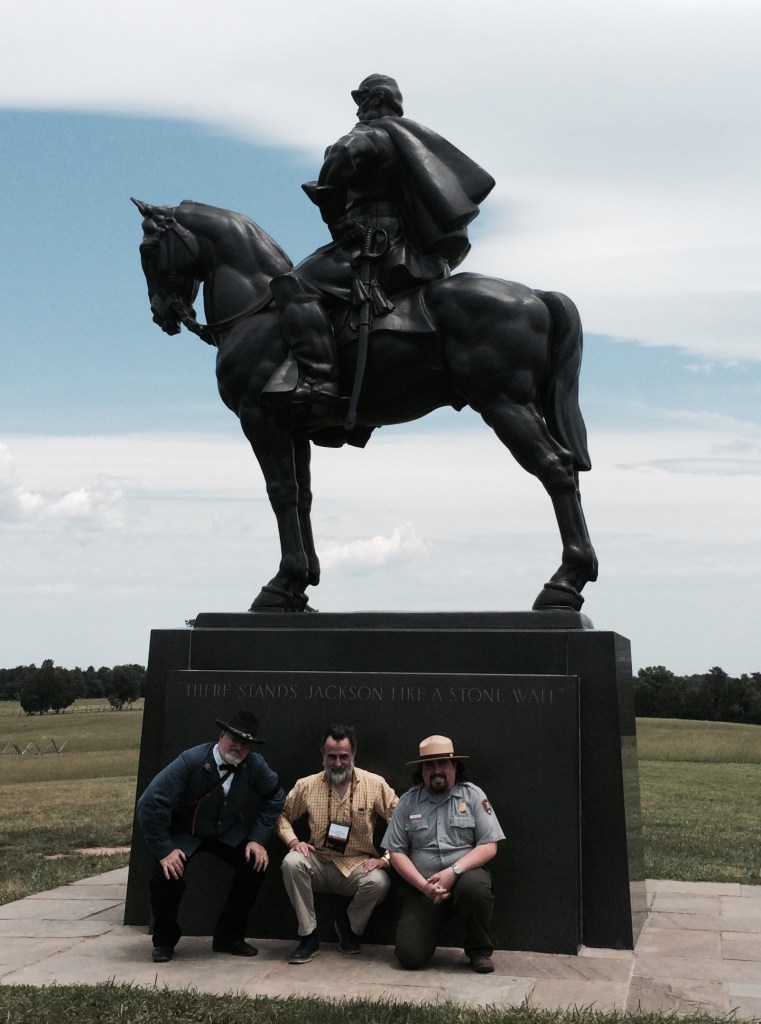
Piece of history: With Stonewall Jackson in Virginia
Take our statues, those we put on a podium to look down on us.
Something of a hobbyhorse of your chronicler statues, as much as I’d love to see the royals and empire builders brought down to earth I’m realistic.
And while we do we should be redressing the balance by putting up more statues of our women, animals, cultural, sports, entertainment and international icons.
And maybe even objects of national endearment like the National Express coach.
Because be sure if it had been around in Dick Whittington’s Day he’d have hopped on it.
Out of Africa
Statue ahoy: Sailormen
It was rewarding too to see a celebration of post-colonial empowerment.
London In the statue of Malawian John Chilembwe which occupies the fourth plinth in Trafalgar Square.
Where he towers over the colonial ruler and where he is now the only African and person of colour thus celebrated.
The fourth plinth should be something we all hold onto.
It is an idiosyncrasy in the square dominated by Admiral Horatio Nelson, victor of the Napoleonic naval battle, that there is another plinth up for grabs.
Three corners are occupied by the ruling elite, King George IV, Henry Havelock and Charles James Napier.
Havewho, Napiehow? Yes, quite. Havelock and Napier were bigwigs during the Indian Raj.
The fourth plinth
Jesus: And Mark Wallinger
The reason why we should embrace the fourth plinth, originally meant for King William IV, 180 years ago, is that it is now a rolling statue.
No, not like Edward Colston who was rolled into the river in Bristol.
But every couple of years an artist’s new statue goes up.
Mark Wallinger’s Ecco Homo of Christ in 1999 making way to a number of others including an Anthony Gormley erection (stop it)!
To just now and Samson Gambalu’s Antelope which will come down in a year.
To accommodate Teresa Margolles’ 850 Improntas, casts of the faces of 850 trans people from London and the world.
The fourth plinth truly does sound like the solution, the future… London a national monument.
And something I’ll be recommending to Edinburgh council.
To pull down the spaceship of Walter Scott and replace it with the city’s most famous citizen, Sean Connery.
As the song goes it’s as simple as ABC… of stag and hen parties in Europe (OK, a bit of poetic licence here, but you try doing this every day!)
The rather clumsy lead-in just gives us an excuse to highlight the charms of our continent’s cities and its appeal to stags and hens.
Now you’ll have your own pick of the pubs but the A-1 for us before we tied the knot was our old stomping ground at the time, Aberdeen, in the north-east of Scotland.
Where the jokers, mostly those who have never been to the Granite or Silver City by the North Sea, will tar the locals with a parsimony that is misplaced.
But for those who have lived there (eight years for me) it is welcoming and best of all the pubs are hubs of good craic.
Too much so on the night in question when I was persuaded by my usher into drinking too much which forced me to retreat from my own do when we got to the Chinese restaurant.
Thankfully we had decided in advance not to have the stag the night before and I’d recovered by the following week.
This could be Amsterdam or Rotterdam
Can I be trusted on a bike? In Amsterdam
Our survey suppliers today Bonusetu (no, us neither) have inexplicably bypassed Aberdeen on their ABC… of stag and hen parties in Europe.
But they do give us some of our favourite cities, starting off with one of the masters, Amsterdam.
And it would be a mistake for revellers to descend on the Red Light district… far better to seek out the cosy, narrow, canalside bars.
The Dutch capital takes top spot for restaurants featured in the Michelin Guide per capita with 70 restaurants making for more than six per 100k population.
Ranking fifth in casinos per capita, sixth for number of five star hotels, and fourth for five star nightlife locations, the Dutch capital has it all.
Now we all have our ideas of romantic getaways and I won brownie points for taking Mrs M to the Dylan where George and Amal go when in Amsterdam.
But just as good I find is taking your loved one down to Rotterdam to see the Dutch Oranje play Greece I find too.
The upside of Continental Europe for your stag or hen is that it’s proper beer and the Belgians make theirs a matter of national honour as we found out in Ieper and Bruges.
Antwerp or Bucharest
Bucks on tour: Bucharest
But the same goes too for Bonusetu’s pick Antwerp where old friends from Dublin (and more of the Fair City later) await.
They tell us that it contains the second most Michelin Guide restaurants per capita at just over five per 100k, whilst ranking 12th relatively for five starred nightlife locations.
Now, full reveal here, and we’d have imagined that the B Bonusetu would have in mind might have been Barcelona or Berlin or Budapest.
But our guides have pointed us in the direction of Bucharest.
The Romanian capital has a huge amount of top class nightlife with more than 50 bars, clubs and comedy clubs rated over five stars on TripAdvisor.
And it has by far the most casinos with 160 which equates to nearly 9 per 100k residents.
Now you bet that we say where Bonusetu are going with this and what they want us to do when we’re abroad, but we’ll go with it.
Fairytale cities
Walking on air in Copenhagen
Heading north Bonusetu clearly know what they think is wonderful about Copenhagen.
The Danish capital sports just over 1.5 casinos per 100k residents, and more than four Michelin restaurants per 100k.
And it has almost 40 five star rated nightlife locations… but the abiding beauty is, of course, the Little Mermaid.
Prague has a fairytale aspect too and its mix of quirky David Cerny Piss Sculpture and historic erections (steady).
But most importantly it claims to have the most beer drinkers per capita in the world.
Bonsusetu helpfully tells us the Czechia capital has the most five star rated nightlife locations per capita of all cities in Europe with 162 across the city.
And that equates to more than 12 per 100k of the population.
Prague also sports the second highest number of casinos with 56 they inevitably tell us.
Eternal cities
I’ll be back: The Trevi Fountain in Rome
Rome needs little build-up and drinking Chianti with a pezzo on the Spanish Steps or Cakestand is to be recommended (guilty).
And our guides tell us of their 124 five-star rated nightlife locations across the city.
As the city with the most top notch hotels per capita in Europe with almost two for every 100k of its population, it’s a sure spot for a fantastic stag/hen do.
As is Lisbon, the jewel of Portugal. Sporting the third most five star hotels per capita at just over one and a half, it maintains a good rank for nightlife.
And we’d of course recommend the Vinho Verde and the sardines whichever fado bar you go into… and a Port to finish.
For those in these island where I live, of course, your question is bound to be which of Britain or Ireland comes out on top in the Bonusetu survey?
London or Dublin
The Travel pack in Dublin
And this time, it’s Laaandon, although we do know that’s because of the Irish influence.
London’s 163 five star hotels puts it second in the per capita rankings with this making for 1.75 per 100k people.
It also features the third highest number of casinos with 53, and an abundance of Michelin Guide restaurants put it at ninth in this category with 0.57 per 100k population.
The Bachelor Boy himself, my own Son and Heir, would only partake in someone else’s stag.
Our own old playground of Dublin has long been on the map for stag and hen revellers, particularly around Temple Bar.
The Fair City ranks third in terms of casinos per capita of these European cities with almost two for every 100k residents, and again in the top ten for five star hotels per capita.
So there you are the ABC… of stag and hen parties in Europe.
Why Lin-Manuel Miranda didn’t cast this ‘son of a Scotsman, who grew up to be a hero and a scholar’, is one of musical history’s great mysteries but keep an eye out just in case, on your Hamilton hols in London.
So never mind that they got the date wrong and Charles will be crowned King Charles III on May 6, he won’t be the best mister at Westminster.
There goes my knighthood or MBE, CBE or OBE although I’ll live with that as I don’t want to be part of any empire anyway.
Westminster which pedants will remind you, but not me, is actually separate from London.
And it is familiar territory for kings and queens ever since Norman Willie.
Or William the Conqueror as he has come to be known, was the first English king to be crowned there.
Since then there have been 39.
And while the late Queen is buried next to her husband Philip in Windsor Castle 30 of her predecessors including Elizabeth I have Westminster as their final resting place.
Written in the tombs
Fawn over the poets: CS Lewis’s Narnia
So in terms of social oneupman or womanship and social mobility then get buried at Westminster.
And lie for eternity with all those royals would probably rank as the ultimate for monarchists.
Sir Isaac Newton, Charles Darwin, David Livingstone and Stephen Hawking are among the 3,000 dead people in the Abbey.
Now for all its royalty, the Abbey does reserve a special place for us scribblers.
They’ve probably got a special place reserved for yours truly (sorry to disappoint).
Geoffrey Chaucer, him of Canterbury Tales fame was first to be laid to rest here.
And Thomas Hardy, Rudyard Kipling, CS Lewis, Ted Hughes and Philip Larkin.
Among others have all muscled their way in there too.
What the Dickens!
Whip around for Dickens’ funeral: Oliver Twist
Charles Dickens too though they’ll tell you down in his adopted Rochester in Kent that he wanted to rest for eternity there.
But that the media pushed for Westminster, and won.
It’s not all doom and gloom though with the Abbey witnessing 16 royal weddings.
Including the Queen and Prince Philip and Prince William and Princess Kate.
Although the least said about Prince Andrew and Sarah Ferguson the better.
Among all the pomp and grandeur and there are some serious attention-seeking tombs in the Abbey one stands out for me.
And he too didn’t really want the fuss either.
Wilberforce of nature
On a pedestal: Wilberforce
William Wilberforce who did more than any man to bring about the abolition of slavery from Britain and its colonial lands is buried in the Abbey.
But he had chosen a vault in Stoke Newington for his burial.
Before parliament interfered and ensured his body was laid to rest there in 1833.
Of course the once-republican Liz Truss and her appalling Dickensian cast of ministers will be doing their best to be seen at King Charles III’s coronation.
And of course he will be the man, though not my man…
That’s Wilberforce, the best mister at Westminster and one who deserves to be put on a pedestal.