It’s often called a living museum and as we shake down the new UNESCO sites and celebrate Il Bel Paese’s pre-eminence.. Italy’s history written on the walls.
The addition of Bologna’s porticoes and Padova’s frescoes makes Italy numero uno with 58 recognised sites.
Arches of triumph
Walk this way: Bologna
Donata McGlynn (she married an Italian) would tear her luscious brown hair out teaching me Italian of a morning.
We would do whistle-stop visits around her homeland in the exercises she set to test nostra lingua.
And we, of course, passed through Bologna’s porticoes which gave us plenty of practise our directions.
The porticoes date back to the 12th century and span over 39 miles with most found in the city.
Made of wood, stone, brick, or reinforced concrete they serve as entrances to arcades and workshops.
And naturally have become hubs for Italians to chatter, or chiacchiera, a beautiful onomatopoeic word.
Of course all with the hands, or parlare con le mani.
Padova’s frescoes
To the greater glory: Padova
Of course, Renaissance Italy all started out with… Giotto in Padova.
Long before Michelangelo got to work on his Sistine Chapel Giotto was setting the template in Padova.
His showpiece the Scrovegni Chapel.
All of which you can learn about by googling. But much more fun coming with me on my Padova journey
UNESCO didn’t just stop there although you could easily while away an afternoon… and I did.
And an advance party to Venice
There are eight religious and secular building complexes which make up Padova’s 14th century fresco cycle.
So why not start your UNESCO Historic Sites of Italy in Padova.
Where its Botanical Gardens are already rightfully on the list.
Up there with those to avoid in life, like taxmen and Ed Sheeran, are those who say Venice is dying… well, on this, their 1600th anniversary year, here’s to the next 1600.
Firstly, the world’s most famous city on a lagoon, has thrived for 1600 years already through plague, foe and the elements.
And despite the doom mongers’ prophecies Venice is actually better placed for the next 1600 years than any of the 1600 before.
No, not because of that picture of that dolphin returning to the Grand Canal which proved the effect of climate change.
No, that was a fake. But because, surprise, surprise, the Venetians know more about preserving their unique way of life than anybody else.
The celebrations have been in full flow since late last month and will run until March 25 next year.
So plenty of time to plan for Veniceophiles (OK I made that term up) to return to a city we have been away from too long.
We return too to the Chronican Altinate (no, me neither) and diarist Marin Sanudo for detail on Venice’s beginnings.
Sanudo referenced the San Giacomo di Rialto as being the first church, begun on March 24, 421.
These days, of course, we have the internet to go to.
And as mia moglie will tell you I’m always happy to let someone else to do the heavy lifting.
Just follow the Venezia calendar on their site for a host of cultural and historical events which you can follow.
And because this week I’ll be hooking up with my German pals for a virtual celebration of Beethoven, this being the 250th anniversary of his birth, I give you the classics.
Ear, ear Beethoven
This one’s for Elise
Beethoven, Teplice, Czech Republic: And you’d expect to see Ludwig in this wellness town back in the 18th Century.
Because Bohemia was part of the Austro-Hungarian Empire and Vienna and Prague were musical centres where Germans flocked to.
I paid my tribute to The Great Man this year at the Beethoven Spa Hotel in Teplice where he stayed, and his room is still there for him.
And he got treatment for his ears, tried out some funky horns and left his death mask.
We also tried out the titular cafe, and the hot chocolate and chocolate cake for research purposes. An empty piano awaited the maestro.
If Beethoven had written a Fur Katarina I’d point you to that in celebration of our host and my pal, but we have the equally enchanting Elise, so here’s Fur Elise.
Rock me Amadeus
Eine Kleine Sadie Music
Mozart, Salzburg, Austria: And, yes, the Austrian singer Falco toasted Mozart with this hit.
A Wiener, he was what Mozart wanted to be, though almost certainly not in musical terms, but certainly in his origins.
Wolfgang was no fan of his home place, Salzburg, which he thought had a small-town attitude.
High standards. We loved it on out ski trip to Soll (it is a Sound if Music Mecca too).
Although the museums are too spread out, you do get right under Wolfie’s skin ;and hair). Here’s Eine Kleine Nachtmusik, pretty much the only German I know.
Vivaldi’s Veneto
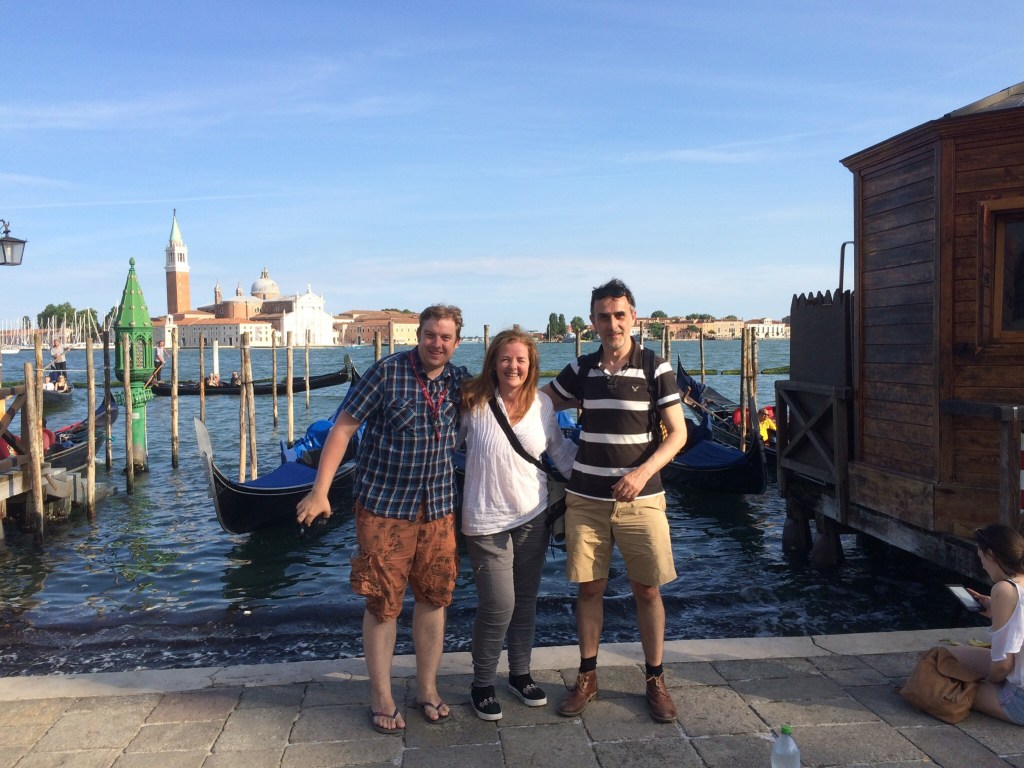
The Dragon, Constsnce and Bandanaman in Venice
Vivaldi, Padova/Veneto: And for many, particularly the Eighties generation, punk violinist Nigel Kennedy, and his rendition of Four Seasons, was it for classical music.
I don’t know if Kieran ‘The Dragon’ who was in our party in Padova was an aficionado but he took casual chic to a new level.
I take some responsibility as I’d wheeled him and fellow Venice newbie Constance out to Lagoon City.
We were back late but had each taken a change of clothes while Dragon was still in his boardies.
While the orchestra were kitted out and the waiters and waitresses too in the sumptuous Padova Botanical Gardens.
Puccini, Prague: And long before rockers namechecked cities, the Classical composers were doing it.
Whisper it, the opera is set in Paris, the Bohemian bit is the fun label attached to what are modern-day Czechs.
And so, for me, the ideal place to watch Giacomo Puccini’s Classic is the State Opera in Prague.
Everybody loves to party in Prague, monks in the Strahov Monastery Brewery and priests swigging Champagne during the intermission at the State Opera.
Handel with care
No cats or mice allowed
Handel Dublin: And George Handel chose Dublin, the second city of the Empire, because he felt the London audiences had started to take him for granted.
No shrinking violet George, there was a statue to him erected in Dublin while he was still alive.
The premiere was packed and ladies were asked not to wear hooped dresses so as to allow more in.
That show was performed at the Musick Hall in Fishamble Street. Now you’ll want to go to Christchurch Cathedral for your opera fix.
But not the place for a cat or a mouse whose mummified remains are on display in the cathedral’s crypt…. they’d got stuck in the organ.
It’s immortalised in James Joyce’s Finnegans Wake.
Anyhoos Christ Church Cathedral puts on recitals and thanks to my friends at Travel Department we channeled old Handel one balmy evening.
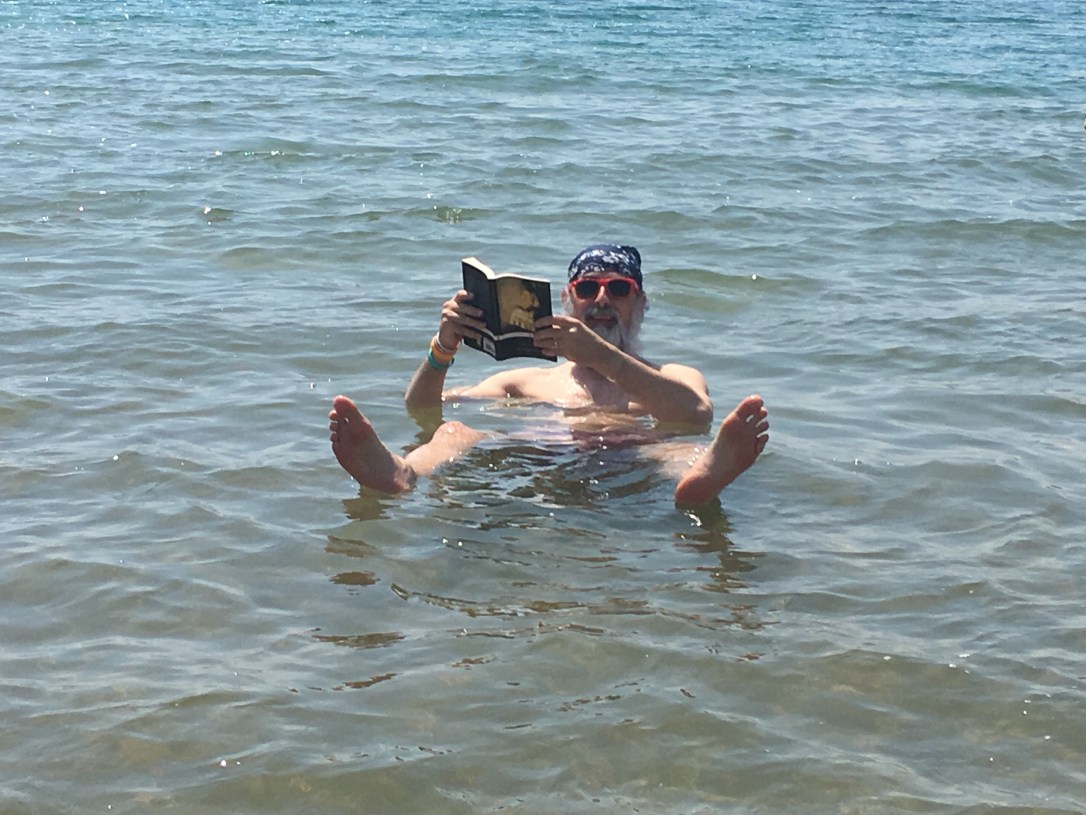
And herein a lesson to us all. I altruistically opted for the alternative Jordan trip rather than leave my workmates to cover me for another week.
It did allow me to empathise with Moses when he reached Mount Nebo and looked over The Promised Land but was forbidden to enter because of a row with God.
I’ve been trying to get on God’s good side praying furiously in lockdown… I don’t want to give HIM any reason to block me.
Auld Greeky
Echoes of Athens in Edinburgh
And this one you’ll get if you’re from Edinburgh or are a fan of the Scottish capital.
The city was known as Auld Reeky on account of the smell which came up from the lochs, or lakes, across from the Old Town.
Which was dredged and made into today’s Princes Street Gardens with bridges put over the new land to the newly-built New Town.
Athens of the North
And the architecture inspired the name Athens of the North.
As calling cards go it does the job – simple, functional and just what is needed if your stock painting will be halos.
With a swish and a brush of red paint Giotto di Bondone had announced himself to the Papal envoy with his freehand circle.
And within a few years he would announce himself to the world with his magnum opus.
His fresco in 1305 in the Scrovegni Chapel in Padova would in turn inspire Michelangelo when he came to adorn the ceiling of the Sistine Chapel.
For all of us who have attempted a still life and ended up with an egg in a basket of fruit instead of an orange you will know how difficult it is to draw the perfect circle.
But only perfect circles would do as Giotto’s patron Enrico Scrovegni had let his halo slip and needed a grand gesture.
To gain absolution and enter through the gates of heaven.
Enrico’s crime was usury – charging excessive interest on loans.
A crime so serious that it resulted in the banker being damned the fires of Hell.
Worth a shot in Ireland.
Rather than appealing straight to Our Lord, though, Scrovegni had the bright idea of asking Jesus’s mother to intercede on his behalf.
Mary cradles Christ
And then dedicated the chapel and the frescoes to her life with a celebration of her role in human salvation.
And just to leave nobody in any doubt of his devotion he had Giotto paint him into the main scene.
Presenting a model of the chapel to her in the fresco The Last Judgment.
The Scrovegni Chapel is Padova’s calling card but it is only a hint of a more expansive canvas.
I am in Padova (Padua), 38km west of Venice in the Veneto region and 209kms from Milan.
St Anthony’s Basilica
As well as looking upwards – Padova is the City of Frescoes – it looks outwards.
It has been home to the Venetians, French and Austro-Hungarians over the last millennium and embraced all their influences.
Today it is looking westwards which is where we Irish probably come in.
But more immediately to Milan’s Expo 2015, a showcase for feeding the planet and energy for life.
Padova has a rich history of doing both.
The Brenta River which leads right down to the Grand Canal teems with life.
While the Venetian Plain attracted the mariners of that great city to avail of its rich agriculture.
And build grand villas and palaces to entertain dignitaries.
It is also home to the oldest botanical gardens in the world.
On this trip, we will get to witness all of this.
But today it’s Sunday so Church and a visit to the Basilica of St Anthony of Padova.
The Piazza dei Signori
Yes, that St Anthony, the one who helps you – for some coins in his charity box – to find your keys,
St Anthony we are told has a wider reach than just those objects that fall out of your rucksacks and handbags.
He is also the patron saint of people who have lost their way in life or lost or fear losing something or someone close to them.
St Anthony’s bones are kept in an altar tomb in the basilica and people pass it in veneration, touching the side.
Which is adorned with photos of their loved ones.
A little bit more of St Anthony
The image of a young man, his head bowed and his hand placed on the side in silent invocation was truly moving.
I have to confess that this simple devotion touched me more than the veneration to St Anthony’s tongue and the bottom of his teeth in elaborate gold reliquaries further up the church.
The story goes that when St Anthony’s body was exhumed his tongue was still moist in recognition of his great preaching prowess.
So the Padovans decided to place it on show for veneration.
St Anthony hailed from Lisbon, but had he been Italian then you’d have to think his hands would have been on display.
Water, water everywhere
They are a famously expressive people, the Italians.
And while in the big cities there is less of a willingness to indulge those who wish to try out their Italian.
I found the Padovans and, in particular, our guide Mariaclaudia charmingly engaging.
Perhaps it is because this is a university city but not just any old university city, among the top ten oldest in the world.
And where Galileo taught.
Naturally the statue to him which is among 78 in the Isola Memmia in the Prato della Valle portrays him with his hands outstretched.
It is also where the first woman anywhere in the world graduated.
Piazza special
An inclusive place then and one where you can, if you don’t have two left feet like your writer, get up to dance the tango.
With dozens of other Padovans in the piazza at night.
The Villa Pisani
Perhaps with another glass of Venetian Spritz – the local speciality of Aperol (think Campari), Prosecco and mineral water.
Well, next time.
My own personal foodie
A word on the food and drink.
I had the good fortune to have accomplished Travel writer, food expert and bon viveur Peter on our trip.
I’m insisting that he come on all my future expeditions with me.
To describe in erudite fashion how good the likes of regional favourite Risi e bisi is.
A merely English translation as rice and peas clearly doesn’t do it justice.
So it’s best left in Italian.
A work of art on a plate
I’m sure other restaurants do Risi e bisi just as well as Taverna degli Artisti but my dish came at the end of an enchanting visit to Cittadella.
It is a 13th Century walled city which stands 14-16ft high and 4,793ft around.
Taverna degli Artisti stands opposite the quaint old we entered behind a market stall.
And through what looked like a lock-up door.
A treasure more memorable because it feels hidden away.
A touch of colour
There is nothing shy and retiring though about the baroque Villa Pisani in Stra on the banks of the Brenta.
Built by Alvise Pisani, the 114th Doge, or leader, of Venice in 1735, there would be 114 rooms.
Villa thriller
With frescoes of gods and men and women living and loving lustily.
With vino flowing as copiously as the water on the nearby Brenta.
And without the dams that that river employs to hold it back.
In the pink
Pride of place in the villa is Napoleon Bonaparte’s bedroom – the little general bought it in 1806.
Bony’s bed
Bony’s bedroom is surrounded by empirical emblems and deliberately is the first the sun hits in the morning.
Not to be outdone, Benito Mussolini and Adolf Hitler met here in Villa Pisani for the first time.
One imagines there must have been a fight to get Bony’s bed.
The Villa Pisani comes with its very own maze, the Labyrinth of Love.
Where we are told a young cloaked woman would stand in the centre at the top of a spiral staircase.
Amazing maze
She was, of course, the prize for the man who managed to wend his way through the maze.
There is no historical record that Bony, Benito or Adolf burrowed their way manically through the maze.
But you would imagine that like us, they did.
We can only assume too that the young woman was on a day off when we visited!
But anyway it was time to get back on our burchiello – or boat.
As we skirted along the river at a gentle pace, gurgling wine and scoffing hors d’oeuvres we feel like those nobles of old.
Energy of the water
We are informed that many of the villas along the banks are also richly blessed but lie empty, still needing to be renovated.
It is a theme that keeps recurring: that the Italians, having finished what they had set out to build during the Renaissance packed up early.
And laid back and enjoyed the fruits of their labour.
So with dragonflies gently skimming along the water by our side I contemplate how the energy of life sometimes has to come in great rushes.
But it is often best captured in quiet moments and in water colours.
A gondola by the banks suggests Venice is drawing nearer but that is for another time.
Merchant of Menace
And besides the Brenta boat voyage runs both ways and it was inland to Padova and its environs that the Venetians, after all, came for their pleasure and sustenance.
So, who am I to argue?
Travel facts
How to get there: Aer Lingus flies to Venice on Fridays, returning Sundays.
Package: The Only Weekend Padova option offers a double room in the central Hotel Europa which offers a comfy night’s stay, a balcony and breakfast. For two nights at €155.
Besides free admission the Padova Card www.padovacard.it also provides discounts on attractions and allows visitors to use urban transit buses for free.
This article was first published in the Irish Daily Mail.




 And our breakaway party from our trip to

 Can I be trusted on a bike? In Amsterdam


 Eine Kleine Sadie Music
 The Dragon, Constsnce and Bandanaman in Venice


 Rome, it has msn a lovely dome